
Some of my earliest memories are astrologically based. It was quite simple really. The break-out year of 1986 brought about a space-themed focus in reception at school. There were three reasons why:
- The launch of the Space Shuttle Challenger – 28 January
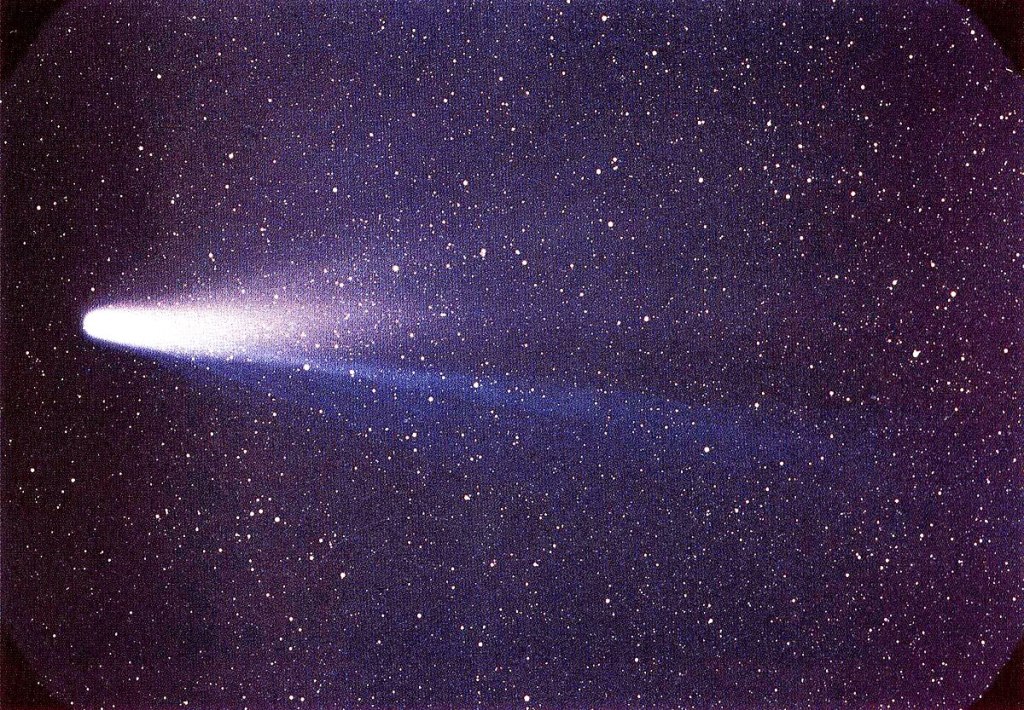
- Halley’s Comet on its approach past Earth – 10 April
- A total lunar eclipse – 17 / 18 October
Space Shuttle disaster
I don’t really want to delve too much into the first one for obvious reasons. There’s plenty of people far more qualified than I to recount the tragedy. What I do remember is our class was invited to stay behind at school to watch a special edition of the BBC programme Newsround – a news-based programme aimed at children.
This episode would cover the launch of Challenger from Cape Canaveral in Florida. We could bring a party food item with us so that we could all enjoy a picnic tea after the programme aired. It was just a few days after my birthday, so it was a great chance to enjoy some time with my fledgling friends.
There was great interest in this launch of Challenger. Christa McAuliffe was on board as part of NASA’s Teacher in Space programme – she was supposed to become the first schoolteacher in space.
The school’s ramshackle TV was rolled out into the cente of the classroom and we enjoyed some kind of cartoon before the main event itself. Newsround was broadcasting around 20 minutes after the live launch. There was a great sense of anticipation when the programme started – our young eyes were ready to see a rocket blast off into space.
Instead we were greeted by a very sombre presenter who mentioned something about reports of an explosion, with a brief picture of a fireball overlaying his words. A teacher then hurriedly threw a sheet over the TV, whilst another quickly pulled the plug out of the socket on the wall. It was rolled back into its cupboard, and we were hastily ushered to the party food, which was opened early. Once we tucking into sandwiches, sausage rolls, and crisps, the glimpse of tragedy that had taken place was soon forgotten – it only fully transpired to our young minds in the months and years to come.
Dark side of the moon?
By the time the total eclipse of the moon arrived in October of that year, many people had lost their fleeting interest in space. Thankfully not in our street! We didn’t do much as a community, people came and went, getting on with their every-day lives. This was one of the occasions that I can remember the majority of our neighbours coming out of their homes to take in the eclipse.
Living close to where the Humber Estuary meets the North Sea, we are blessed with a relatively unobstructed view of the Eastern sky. That made for some great views on the evening of 17 October.
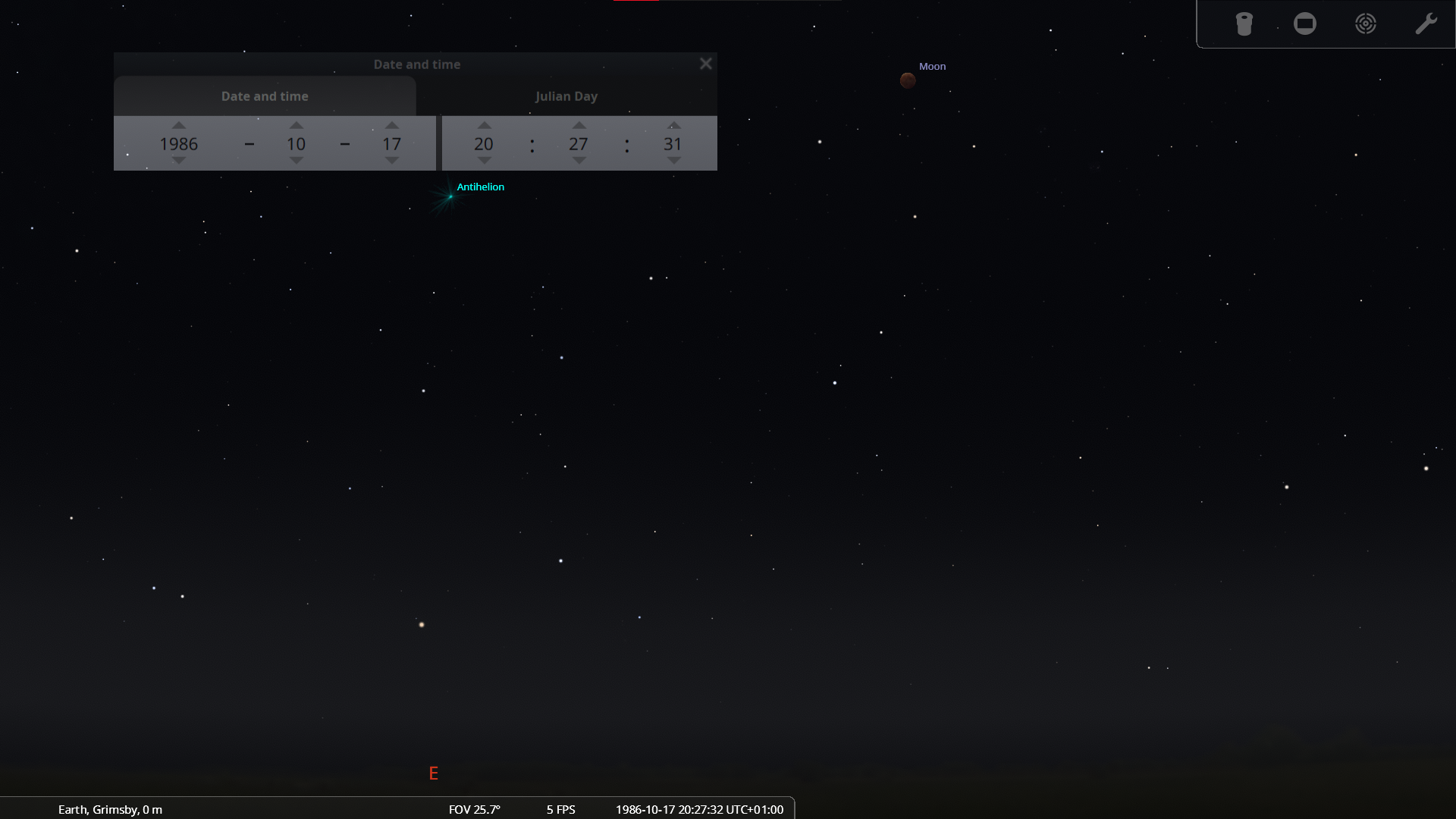
I can remember chewing my way through some Fruitellas (because our corner shop didn’t have any Chewits in stock), gazing up at the night sky. It seemed to take hours for he eclipse to actually happen. I guess it is also a Mandela Effect, as I was convinced for years that the moon completely disappeared from view – that’s of course not what happens in a lunar eclipse, it went a striking shade of pink as it passed into the earth’s umbral shadow. I took a photo of it on a Kodak Instamatic. Or at least I thought I did, it developed as the pure blackness of space!
It was a significant celestial event to tick off early in life. It was also fitting when I took my eldest daughter to experience an eclipse just before dawn on 19 November 2021, albeit a partial one. We’re looking forward to seeing a total lunar eclipse in 2025.
All hail Halley
So let’s go back to what this post was originally about – Halley’s Comet. As mentioned above, our views of eastern skies is pretty much unobstructured.
There’s countless comets out there in our solar system but Halley’s seems to capture the imagination more than most. Perhaps it is its instantly recognisable and visible tail or the fact you can just about see it twice in a lifetime or that we’ve been depicting its passes for hundreds of years – when you think of a comet, you instantly think of Halley’s.
After the Challenger disaster just months prior, the hype around Halley’s dimmed somewhat at school but we still ventured out as a household to try and capture a glimpse of Halley’s Comet, even if it did mean an extremely early start.
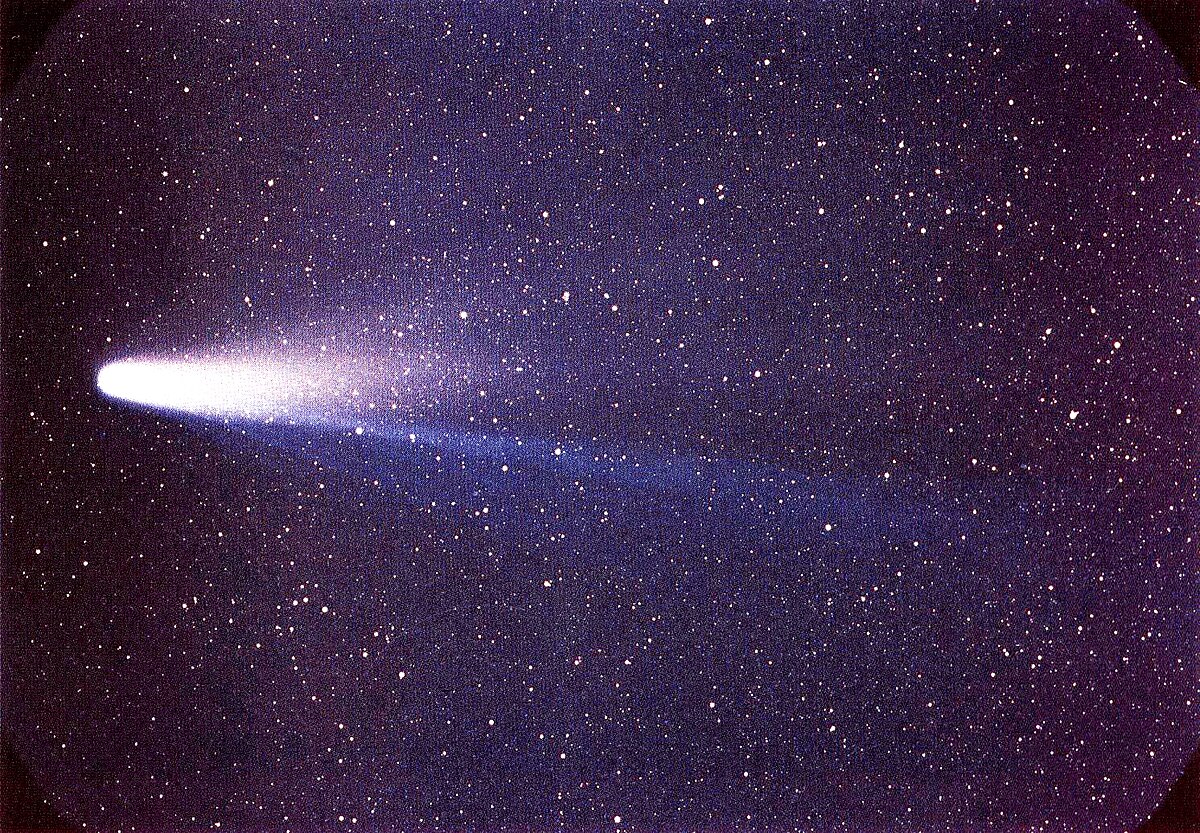
I’ll never forget seeing Halley’s Comet in the sky. It looks like it stepped straight off the pages of a book. Like the best firework you’ve ever seen. It looks like its dropping out of the sky into the sea in the distance. It doesn’t look like it’s over 60 million kilometres away from you.
The children are into space. My eldest daughter woke up early one Friday morning in January 2023, so we decided to go stargazing. We were using our newest telescope and binoculaurs, scanning the sky for stars and constellations that we’re familar with, when a smudge of green caught our eye – Comet C/2022 E3.
This prompted us to join our local observatory. I can fudge my way around the night sky but the opportunity to learn more and have professional equipment on hand, right on our doorstep, proved too much of a great chance to turn down.
Fast forward nearly a year and I received an email from the group. Halley’s Comet had reached aphelion – a distance of over 3.2 billion miles, beyond the orbit of Neptune. It began its journey back to us on 10 December 2023. When it reaches perihelion again on 28 July 2061 – I will be 79 – will I even be around to see it? I would love to be, to see it with my daughters and bring the story full circle.
I find space a sobering and grounding topic. In those 38 years since I stood on a back-street in Cleethorpes to catch a glance at this gift from the heavens, it’s travelled billions of miles away from us, who knows what it’s encountered in that time. What have I achieved in a similar timeframe? I guess it is all relative and perhaps up to someone else to judge.



 Notes from NE Lincs
Leave a comment